
Image courtesy of TCGdex.net
Synergy through data: a closer look at Throh in a modern card-database mindset
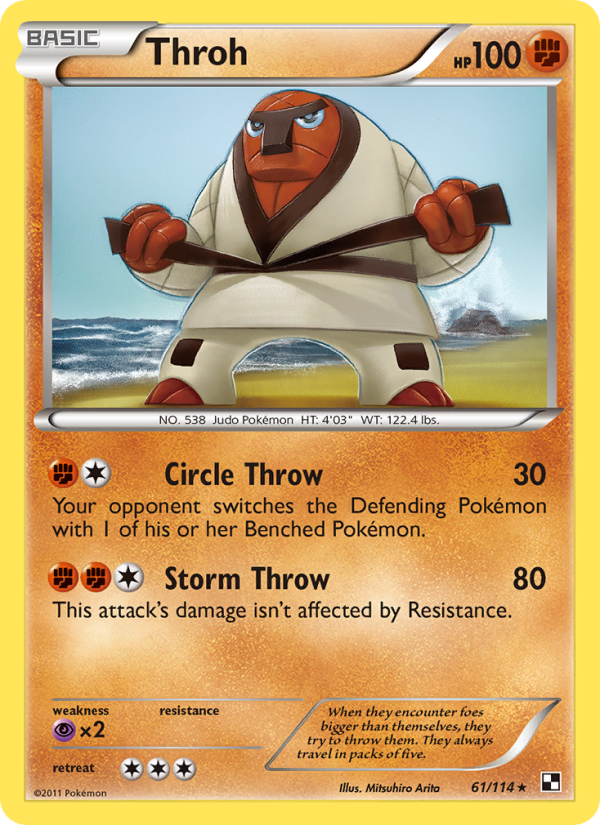
In the Pokémon Trading Card Game, the true art of synergy emerges when you blend card text with the bigger picture painted by card databases. Those databases track rarity, HP, retreat costs, and the fine print on attacks, turning a single card like Throh into a hinge around which a deck design can pivot. Throh, a basic Fighting-type Pokémon from the Black & White set (BW1), might look modest at first glance with 100 HP and two straightforward attacks. But in the hands of a data-minded trainer, this humble figure becomes a tool for bench manipulation, tempo shifts, and strategy levers that ripple across turns ⚡🔥.
Throh at a glance
- Name: Throh
- Set: Black & White (BW1)
- Rarity: Rare
- Type: Fighting
- Stage: Basic
- HP: 100
- Illustrator: Mitsuhiro Arita
- Weakness: Psychic ×2
- Retreat: 3
What the databases reveal beyond these basics is how Throh plays in a live match. The BW1 era card carries a signature that rewards deliberate bench management and clever timing. It’s a reminder that even a basic Pokémon can become a linchpin in a strategy built around disruption and calculated aggression. The card’s existence in the Expanded pool but not standard today is a quick reminder of how the meta rotates, and how collectors and players use databases to trace viability across formats and years 🎴.
Moves that shape the match
Throh’s two attacks tell a tale about tempo and payoff. Circle Throw costs Fighting and Colorless and deals 30 damage while forcing your opponent to switch the Defending Pokémon with one on their Benched lineup. This is not a pure damage card; it’s a deliberate disruption tool. The ability to force a bench swap can unravel an opponent’s plan by shuffling a threatening Pokémon onto the bench or by removing a pinned or stubborn defender from the field.
Storm Throw is the heavier hammer: costs Fighting, Fighting, and Colorless, delivering 80 damage and crucially noting that its damage isn’t affected by Resistance. In practical terms, this means you’re more likely to punch through bulky, resistance-heavy defenders late in a game, especially after you’ve softened or repositioned the field with Circle Throw. The combination of disruption and reliable mid-range power makes Throh a candidate for a control-leaning Fighting deck rather than a brute-force linchpin.
When you pair these traits with a card database mindset, you start to see how synergy unfolds. Circle Throw creates a domino effect: bench-swapping can set Throh up for Storm Throw against a fresh target, or break a strategy that relies on a single tank staying put. In the right matchup—think opponents who rely on a single, high-HP defender—you can tilt the board by alternately manipulating defenses and delivering a clean 80 with Storm Throw. It’s a small but real demonstration of how data-informed play can extract value from even older, “basic” cards 🔥.
Strategic synergies in a Fighting-type shell
From a data-driven perspective, the best Throh decks leverage synergy with other Fighting-type Pokémon and supportive trainers that help sustain bench pressure and field control. A well-tuned Throh line might feature several low-cost attackers that push for early momentum, freeing spaces on the bench for Circle Throw to target key threats. Because Circle Throw forces a bench swap, you can position a more favorable defender on your opponent’s side while you ready Storm Throw for a later turn. The concept is not just about raw numbers; it’s about turning the database insights into a predictable pattern of plays that your opponent has to navigate.
Another layer comes from understanding format legality. Throh’s BW1 card is not standard-legal, but it remains accessible within Expanded play, and that informs how you conceptualize a deck’s life cycle, rotation windows, and collectible value. Databases track not just moves and HP but also format eligibility, giving you a fuller map of both playability and market reality. In other words, you can plan a Throh-focused angle not just for current play—but for a historically informed, collector-aware strategy that respects the card’s rarity and age 💎.
Market and collector insights
From the numbers in the card databases, Throh sits as a Rare card from BW1, with values that reflect its place in the era’s lineup. CardMarket shows average values around the €1 range for non-holo copies, with wide spreads that can spike in the short term depending on demand and condition. The holo and reverse-holo variants typically fetch higher prices, as is common with rarer print runs from early BW sets. On TCGPlayer, normal cards there hover in a similar space, with low prices approaching a few tenths of a dollar and highs ticking toward the couple-dollar mark for well-preserved copies. The market data highlights how collectors value this card not only for its playability in Expanded formats but also for its iconic Mitsuhiro Arita illustration and the nostalgia of the Black & White era 🎨.
For players chasing a budget-friendly, disruption-forward strategy, Throh presents a compelling case: its two attacks deliver reliable utility, its HP is sturdy enough to survive early trades, and its weakness to Psychic does push you to consider supportive matchups or bench protection as you assemble the deck. The data-driven takeaway is that, while Throh may not be the centerpiece of a modern standard deck, it remains a thought-provoking option in Expanded play and a fun, collectible piece for fans who track card history and price trends over time.
Art, lore, and the artist behind the scene
Featuring Mitsuhiro Arita’s signature style, Throh’s art captures the martial spirit and earthy palette of the early BW era. Arita’s work has become a touchstone for many fans who collect the first waves of modern Pokémon cards, and this piece is no exception—grounded in character, with a texture that evokes the rugged nature of a fighter training in a dojo. When you study the card through a database lens, the illustration becomes part of the card’s aura: a tangible reminder of why certain prints remain beloved, even as the meta rotates and formats evolve 💎.
Putting data into practice: a step-by-step Throh deck concept
To translate these insights into a practical build, consider the following approach. Start with 2–3 Throh to anchor the early game and bench-disruption plan. Add a handful of complementary Fighting types that can apply pressure while Throh works the bench. Include Trainers that help manage the bench and tempo—cards that create draws, control the opponent’s board state, or accelerate energy attachment where possible. Remember the synergy: Circle Throw’s bench swap sets up Storm Throw, and the latter’s immunity to Resistance makes it a reliable closer in the right moments. Guard against Psychic-wielding matchups by distributing your damage across threats and using the board state to your advantage. The key is to leverage the data you’ve gathered—HP, retreat, and attack costs—into a clear, recurring sequence that your opponent must adapt to, turn after turn 🕹️.
As you navigate this approach, keep a constant eye on the card’s market signals. If you’re also a collector, Throh in its BW1 form is a reminder of the cross-section where gameplay strategy, rarity, and artist-driven nostalgia meet a lasting impression on the hobby. The synergy is not just about winning games; it’s about building a coherent narrative around a card that has endured since the Black & White era, reinforced by modern data that helps you decide when and how to invest or play.
Ready to explore more data-driven card journeys? Check out the product link below to sharpen your desk with a tool that keeps your workspace as sharp as Throh’s focus.
Foot Shape Neon Ergonomic Mouse Pad with Memory Foam Wrist RestMore from our network
- https://blog.digital-vault.xyz/blog/post/deny-the-witch-visual-composition-and-art-direction-in-mtg/
- https://crypto-acolytes.xyz/blog/post/unleash-superpowers-with-minecraft-dc-comics-mods/
- https://blog.digital-vault.xyz/blog/post/unraveling-the-goblin-trapfinder-illustrators-mtg-legacy/
- https://blog.zero-static.xyz/blog/post/unpacking-captain-rex-nebulas-mtg-flavor-text-references/
- https://crypto-acolytes.xyz/blog/post/top-online-co-op-games-to-play-right-now/