

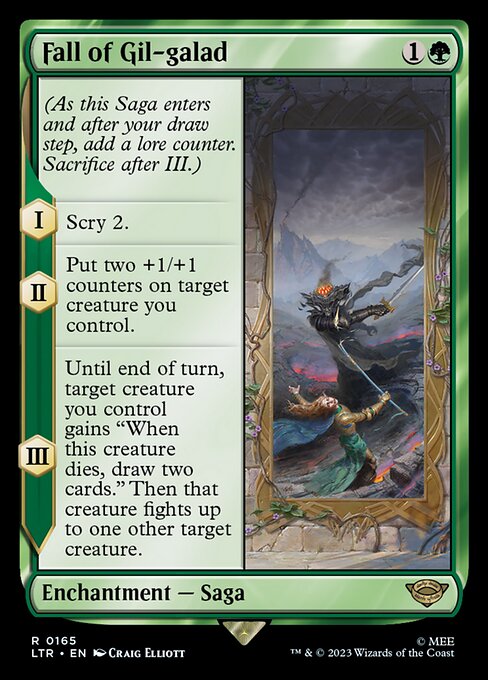
Image courtesy of Scryfall.com
Stacking Similar Effects: Green Saga Playbooks and Beyond
Green remains MTG’s most reliable partner in multi-step value, and the green saga Fall of Gil-galad is a crisp, modern example of stacking related effects to build a cohesive game plan. The card’s three chapters unfold like a mini-arc: first you peek at the future with Scry 2, then you grow your board with two +1/+1 counters, and finally you unleash a temporary, combat-centric swing that can draw you into the next layer of disruption. It’s a satisfying blend of topdeck manipulation, board presence, and tempo, wrapped in a flavorful Tolkien-inspired package 🧙♂️🔥. If you’ve ever wanted a blueprint for decks built around interconnected effects, this Saga is a compact case study worth revisiting.
What makes this design sing is how the three effects reinforce each other. Scry 2 is not just a free peek; it can set up countermoves for II and III. If you see the right line of play, you can deliver two +1/+1 counters on a creature that’s already prominent on the battlefield, then flip the script with a turn-ending fusion of buff, draw, and fight. That final swing is not merely a temporary buff; it’s a vehicle to reward your planning with card advantage right when you most need it. The aesthetic and mechanical logic of this card are a doorway into a family of archetypes that thrives on layering effects in green. 🌱⚔️
1) Scry-driven topdeck precision: the gate to green tempo
The first phase of the Saga demonstrates why Scry remains a cornerstone for many green decks focused on tempo and value. Scry 2 gives you a choice, not a guarantee: you can smooth your mana, fix your draws, or send awkward cards to the bottom when you already have the plan in sight. In decks built around similar effects, you’ll see a consistent emphasis on controlling the early game’s tempo while you assemble the pieces for a decisive mid-to-late game. This topdeck discipline pairs especially well with proliferate or other tempo-centric engines, where every card drawn is a measured step toward victory. 🧭
2) +1/+1 counters as a persistent engine
II’s two +1/+1 counters are not just a stat bump; they’re a long-term investment. Green’s suite of cards that care about counters—whether they’re proliferated, or redistributed via other buffs—turn a single creature into a walk-and-talk engine. When you stack counters across turns, you create inevitability: your creatures become harder to remove, and your opponents must commit larger resources to trade efficiently. It’s a classic green tempo strategy reframed through the Saga lens, with the bonus of a Tolkien-flavored narrative flourish. 💎🎲
3) Fight as a finisher: combat as a path to momentum
The III stage uses a “gain temporary power and force a fight” motif to convert board momentum into a strategic edge. Fighting can disrupt blockers, trigger protective responses, and push a creature into the red zone in a way that pure pump sometimes cannot. The requirement to target a creature you control for the effect creates a risk-reward calculus: you want to maximize the value from the fight, ideally protecting your best creature while forcing a clash that removes a key threat. It’s a design space that rewards careful sequencing and an eye for your opponent’s answers. ⚔️
“Sagas turn micro-interactions into macro-turnarounds. When you align a few straight-line effects, you’re not just playing a spell—you’re telling a multi-chapter tale with each draw step.”
4) Death-driven card draw: every swing pays you back
The final clause—draw two cards when the buffed creature dies—creates a compelling loop. It’s not merely a one-off perk; it’s a door to recasting your plan as you recover from trades and refill your hand with gas. Decks built around this idea emphasize resilience: you want to engineer battles where you can safely exchange a creature into the red zone, knowing the aftermath will fuel your next set of plays. This is nostalgia meets modern efficiency: green gave us card draw in the form of efficient creatures and lores, now repackaged as a staged arc that rewards patient play. 🧙♂️💎
5) Building the archetype: practical direction and cautions
As you sketch out a deck around a triad of effects like Scry, counters, and a temporary fight finisher, you’re courting synergy that doesn’t burn out your resources. Green’s toolkit supports this: ramp to accelerate, card advantage to sustain, and resilient bodies to weather removal. To maximize a Fall of Gil-galad-inspired template, consider weaving in:
- Other Sagas or saga-supporting pieces to create a chain of incremental effects.
- Counters-centric creatures or buff enablers to amplify II’s growth.
- Combat-centric tools that reward successful fights with value and the possibility of wins through combat ladders.
Remember to keep mana solid and the curve friendly. This kind of deck shines when you can sequence I, II, and III cleanly and force strategic decisions from your opponent on each turn. And if you’re curious about practical carry-overs beyond the ring-lore, you’ll find green’s overall resilience to be the best partner for experimenting with “similar effects”—the core idea behind deck archetypes that love to stack like-minded powers to great effect. 🧩🎨
MagSafe Phone Case with Card Holder (Polycarbonate Matte Gloss)Whether you’re drafting a green midrange that leans into scry and growth or building a full-on counters-and-combat machine, Fall of Gil-galad shows how a single card can be a lighthouse for a family of archetypes. The saga’s narrative structure invites you to think multi-turns ahead, to balance tempo with inevitability, and to savor the moment when a carefully engineered fight turns the tide. 🧙♂️🎲
More from our network
- https://crypto-acolytes.xyz/blog/post/the-psychology-of-survival-gaming-why-we-keep-playing/
- https://blog.crypto-articles.xyz/blog/post/solana-meme-coin-risks-amid-falling-momentum-and-tiny-holders/
- https://wiki.digital-vault.xyz/wiki/post/minecraft-block-stats-dead_bush/
- https://blog.rusty-articles.xyz/blog/post/lost-ark-hidden-connections-to-other-games-explained/
- https://crypto-acolytes.xyz/blog/category/space/
Fall of Gil-galad
(As this Saga enters and after your draw step, add a lore counter. Sacrifice after III.)
I — Scry 2.
II — Put two +1/+1 counters on target creature you control.
III — Until end of turn, target creature you control gains "When this creature dies, draw two cards." Then that creature fights up to one other target creature.
ID: fbaab2c0-ea18-4b2f-b75b-506cbbea97e1
Oracle ID: c248537f-e28f-47cb-9e47-a6eb05e1af63
Multiverse IDs: 616995
TCGPlayer ID: 498520
Cardmarket ID: 716004
Colors: G
Color Identity: G
Keywords: Fight, Scry
Rarity: Rare
Released: 2023-06-23
Artist: Craig Elliott
Frame: 2015
Border: black
EDHRec Rank: 7508
Penny Rank: 6310
Set: The Lord of the Rings: Tales of Middle-earth (ltr)
Collector #: 165
Legalities
- Standard — not_legal
- Future — not_legal
- Historic — legal
- Timeless — legal
- Gladiator — legal
- Pioneer — not_legal
- Modern — legal
- Legacy — legal
- Pauper — not_legal
- Vintage — legal
- Penny — legal
- Commander — legal
- Oathbreaker — legal
- Standardbrawl — not_legal
- Brawl — legal
- Alchemy — not_legal
- Paupercommander — not_legal
- Duel — legal
- Oldschool — not_legal
- Premodern — not_legal
- Predh — not_legal
Prices
- USD: 0.18
- USD_FOIL: 0.38
- EUR: 0.37
- EUR_FOIL: 0.54
- TIX: 0.02
More from our network
- https://blog.crypto-articles.xyz/blog/post/nft-data-children-of-cope-15-from-children-of-cope-collection-on-magiceden/
- https://blog.crypto-articles.xyz/blog/post/best-partners-for-kommo-o-gx-decks-in-pokemon-tcg/
- https://blog.crypto-articles.xyz/blog/post/nft-data-b59-from-b33-collection-on-magiceden/
- https://crypto-acolytes.xyz/blog/post/nft-stats-llama-1679-from-la-llama-politically-incorrect-club-collection/
- https://wiki.digital-vault.xyz/wiki/post/pokemon-tcg-stats-wishiwashi-ex-card-id-a3-202/