
Image courtesy of TCGdex.net
Galvantula energy curve optimization data for decks
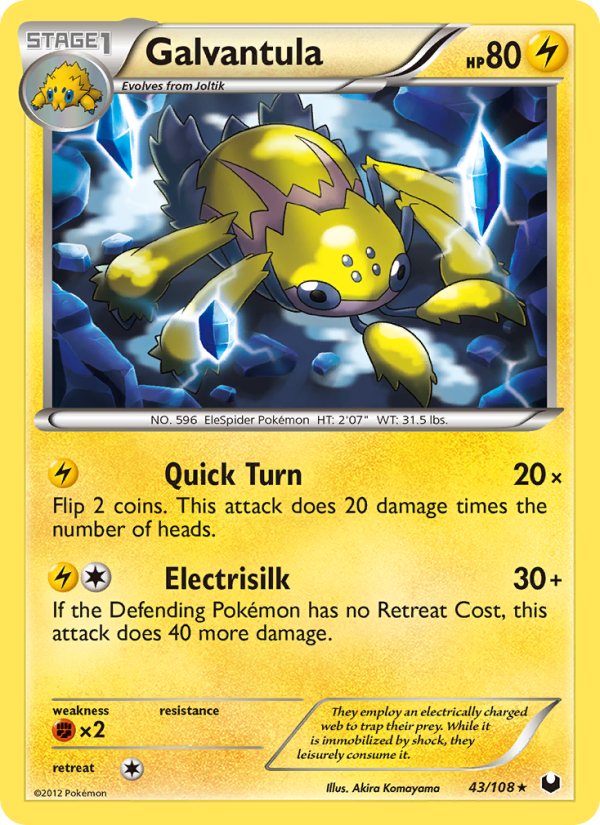
In the Dark Explorers era, every edge counts when you’re building a lean, energy-efficient Lightning strategy. Galvantula, a Rare Stage 1 Pokémon with a nimble 80 HP and a sharp eye for tempo, stands out as a data-driven choice for players who want to tune their energy curves and coin-flip probabilities for maximum consistency. Illustrated by Akira Komayama, this card taps into the electricity-first philosophy of its type and the Joltik lineage to create dynamic play patterns on the table. ⚡🔥
Card snapshot — what you need to know at a glance
- Category: Pokémon
- Name: Galvantula
- Set: Dark Explorers (bw5) — 108 official cards in the full set, with a total of 111 cards in the expanded print run.
- Rarity: Rare
- Stage: Stage 1 (evolves from Joltik)
- Type: Lightning
- HP: 80
- Attacks:
- Quick Turn — Cost: Lightning; Effect: Flip 2 coins. This attack does 20 damage times the number of heads.
- Electrisilk — Cost: Lightning, Colorless; Effect: If the Defending Pokémon has no Retreat Cost, this attack does 40 more damage. Base damage 30.
- Weakness: Fighting ×2
- Retreat Cost: 1
- Illustrator: Akira Komayama
- Evolves From: Joltik
From a strategy lens, Galvantula’s Quick Turn is the kind of trickster move that rewards careful risk assessment. With two coin flips, you can land anywhere from 0 to 40 extra damage on a single turn, but the average expectation sits around 20 damage per use. That makes Galvantula a tempo piece: you’ll want to pair it with energy acceleration and a plan for when to stop in for a knockout vs. when to stall and set up the next attack. The second attack, Electrisilk, brings a more linear payoff, scaling up to 70 damage if your opponent’s active Pokémon has no Retreat Cost—an intrinsic nudge toward pressuring the opponent to pay in retreat energy or to reposition with a retreat move. 🌀
Energy curve thinking — how to optimize around Galvantula
Galvantula’s attack costs drive several practical deck-building decisions. Quick Turn only needs a single Lightning Energy, while Electrisilk asks for one Lightning and one Colorless. In a typical deck, that means you’ll want a healthy supply of Lightning Energy plus a reliable source of colorless energy (think Double Colorless Energy or other flexible energy options) to avoid stalling out on late-game turns. The presence of Colorless in Electrisilk’s cost invites a flexible energy strategy, letting you leverage any energy available in your colorless slots while still committing to a Lightning core for boost damage.
From an optimization standpoint, you’ll often want to load Galvantula into a mid-game tempo plan. Use Quick Turn to test the field and gauge coin outcomes, then pivot to Electrisilk when your opponent’s retreat arrangements create a favorable window. If you can arrange for the Defending Pokémon to have No Retreat Cost (via dynamics in your opponent’s board or your own switch-in timing), Electrisilk becomes a powerful closer. That balance—high-variance Quick Turn with a reliable finisher—drives how you engineer your energy curve throughout the match. ⚡
Deck-building notes and practical tips
- 2-1 line consideration: A common approach is to pair Joltik and Galvantula with a small, fast Lightning engine. The 2-1 line helps you hit the early board with Joltik and then pivot to Galvantula once you’ve established energy acceleration.
- Energy acceleration: Include a handful of Lightning Energy and at least one or two sources of colorless energy (or Double Colorless Energy) to satisfy Electrisilk’s cost without overstuffing your early game.
- Coin-flip management: Quick Turn rewards your planning more than pure luck. Consider techs or strategies that capitalize on multiple coin flips in a turn to keep pressure on your opponent while maintaining board presence.
- Weakness awareness: With Fighting as a ×2 weakness, Galactic pressure from opponents using Fighting-types should shape when you commit Galvantula to the active spot, especially if you’re running a lean deck with fewer healing options.
- Evolution timing: Because Galvantula is Stage 1, you’ll want to ensure your bench has ready Joltik to evolve when you have a moment to spare; the payoff is a longer tail window for your energy curve optimization.
Market pulse and collector insights
For collectors and players watching market trends, Dark Explorers cards have remained a steady target for nuanced investment and nostalgic value. Within the current market snapshot, the card market price for non-holo copies sits around €0.90 on CardMarket with a recent trend around 0.91. In the U.S. market, TCGPlayer data shows typical ranges for the normal (non-foil) version dipping to about $0.50–$1.49, with a market price hovering near $1.28. The holo or reverse-holo variants command a premium, with reverse-holo foils trending higher (mid around $1.81, with market prices above $1.50 and highs pushing near $3.01 for certain listings). These figures reflect Galvantula’s enduring appeal as both a playable card and a nostalgic centerpiece from the Black/White-era arc. Collectors often seek the Akira Komayama art for its distinctive style, as well as the card’s play practicality in older formats where Fast Energy and Colorless synergy could tilt the outcome in a tight matchup. 💎🎨
As the card climbs through price floors and flirts with modest peaks, it remains accessible enough for budget-oriented players while still offering a meaningful upgrade path for Lightning-heavy builds. This balance—playability, collectible appeal, and relatively affordable entry—helps Galvantula stay relevant in energy-focused decks and in the broader Dark Explorers narrative. If you’re chasing a deck’s energy curve optimization with a touch of volatility from coin flips, Galvantula provides a thoughtful, data-driven piece to your puzzle. The artistry of Akira Komayama also adds a layer of visual nostalgia that fans deeply appreciate during casual evenings and tournament weekends. 🎴⚡
Putting it all together
In practice, Galvantula is a compact, tempo-forward addition to a Lightning-centered deck. Its two-pronged attack plan—risk-managed Quick Turn to probe for favorable coin outcomes, followed by Electrisilk to press the tempo when the opponent’s Retreat Costs are unfavorable—offers a reliable route to consistent damage while maintaining energy flexibility. The Dark Explorers set print, with its blend of rare cards and vivid illustrations, remains a touchstone for players who enjoy weaving archetypes around precise energy curves and calculated aggression.
MagSafe Phone Case with Card Holder (Glossy/Matte)More from our network
- https://blog.digital-vault.xyz/blog/post/how-buyouts-shape-small-set-cards-like-apprentice-necromancer/
- https://blog.digital-vault.xyz/blog/post/transparent-paper-art-achieving-depth-through-light/
- https://crypto-acolytes.xyz/blog/post/underrated-ps2-horror-gems-you-need-to-play/
- https://crypto-acolytes.xyz/blog/post/minecraft-trust-experiments-lessons-in-cooperation-and-betrayal/
- https://crypto-acolytes.xyz/blog/post/the-hidden-influence-of-cheat-codes-on-retro-gaming/