
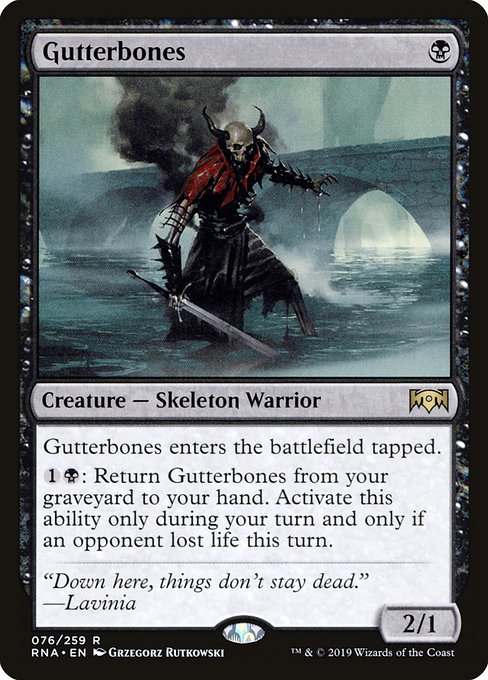
Image courtesy of Scryfall.com
Gutterbones as a Case Study in Balance
In the grand tapestry of Magic: The Gathering, some cards read as simple on the surface yet carry a quiet, deliberate design philosophy. Gutterbones, a black mana creature from Ravnica Allegiance, is one such example 🧙♂️🔥. A 1-mana B skeleton warrior with a 2/1 body, it enters the battlefield tapped, which nibbles at the tempo a touch—but the real elegance lies in its niche recursive capability. This tiny creature embodies a larger design story: complexity that deepens with play, yet remains approachable for newcomers who want to dip their toes into graveyard shenanigans without wading through a swamp of rules text ⚔️🎲.
Design and Complexity in a Tiny Package
- Mana cost and color: {B} keeps Gutterbones in black’s wheelhouse, signaling familiar themes—defiance of death, graveyard politics, and a willingness to trade life for material advantage. This single-icon cost makes it a natural first pick for mono-black or reanimator shells 🧙♂️.
- Rarity and stats: Rare, with a 2/1 body. The stat line is lean, but the ability to come back from the graveyard gives it staying power even when the initial swing is slowed by the enter-tapped condition.
- Enter the battlefield tapped: This is a deliberate tempo cost. It slows the early tempo a touch, inviting thoughtful plays rather than impulsive aggression. The trade-off is a creature that can later return with real surprise value, especially in longer games.
- Recurring ability: {1}{B}: Return this card from your graveyard to your hand. Activate only during your turn and only if an opponent lost life this turn. The constraint is a neat little gate that teaches timing and sequencing: you don’t just slam it for value; you must engineer a life-loss moment—whether through direct damage, a multi-step combat, or opponent misplays—to unlock the loop 🔒💎.
- Lore in flavor and art: The flavor text—“Down here, things don't stay dead.”—pairs with Rutkowski’s moody illustration. It reinforces a theme that is core to black’s identity in MTG: the graveyard as a frontier of possibilities and hard-won resilience 🎨.
“Complexity that rewards thoughtful play, not complexity for its own sake.”
For designers, Gutterbones is a masterclass in balancing accessibility with depth. A new player can grasp the basics quickly—it's a cheap, evasive-looking skeleton that fits into a graveyard strategy. A seasoned player, meanwhile, can experiment with timing windows, life-loss synergies, and recurrences that turn a single card into a recurring engine. The result is a card that feels both friendly and quietly cunning 🧭.
Accessibility, Strategy, and Everyday Play
Gutterbones shines in part because it invites beginners into the black-light world of mana denial, hand disruption, or graveyard synergy without forcing them to parse pages of errata. Its turn-1 drop is a gateway to more ambitious plays—like retreiving the skeleton later in the game after a controlled life-loss event, or weaving it into a broader recursion plan that proves surprisingly consistent in casual and semi-competitive settings.
From a strategic standpoint, you can picture Gutterbones as a tiny engine that wants to be fed with life-loss triggers. While it can slip under the radar as a simple drop, the true payoff comes when you weave it into a sequence where your opponent’s life total dips and you snap it back to hand to recast later. It’s a card that invites both straightforward aggression and more nuanced planning, which is precisely the balance many players search for when learning the game 🧙♂️🎲.
As spice for your collection, its market stance is modest but meaningful. From RNA’s color-coded identity to its rare status, Gutterbones sits as an approachable, value-conscious pick for budget-minded players who still crave a touch of graveyard play. The foil version tends to tilt upward, a nod to collectors who prize the tactile gloss and the lore embedded in a card that whispers, “you can get another shot at this” 💎🧰.
Art, Theme, and the Craft of Black‑Mana Design
The art by Grzegorz Rutkowski captures that moody underworld vibe—the skeleton-walker that lopes through crypts with a purpose. In a set dripping with Ravnican color and street-side intrigue, Gutterbones stands out not as a flashy bomb but as a dependable piece of a larger puzzle. Its narrative hook—resurrection on your own terms—mirrors a broader design ethos: give players a clear, intuitive rule set while leaving room for emergent play patterns that emerge from the deckbuilding stage onward 🖼️🎨.
In the end, Gutterbones isn’t just a card; it’s a microcosm of the Balance of Complexity and Accessibility that Magic designers chase across sets. It offers a quiet lesson in how to teach a powerful concept—graveyard recursion—without overwhelming newcomers with a wall of text. The result is a card that’s easy to pick up, hard to master, and deeply satisfying to activate when the timing is right ⚔️.
Non-Slip Gaming Mouse PadMore from our network
- https://crypto-acolytes.xyz/blog/post/dr3-evidence-shows-hot-blue-star-fits-mainsequence/
- https://crypto-acolytes.xyz/blog/post/unlocking-replay-value-what-makes-games-timeless/
- https://crypto-acolytes.xyz/blog/post/dorado-blue-beacon-reveals-stellar-lifespan-secrets/
- https://transparent-paper.shop/blog/post/detecting-stellar-associations-with-a-distant-blue-giant-at-13000-lightyears/
- https://crypto-acolytes.xyz/blog/post/explore-epic-minecraft-parkour-maps-today/