
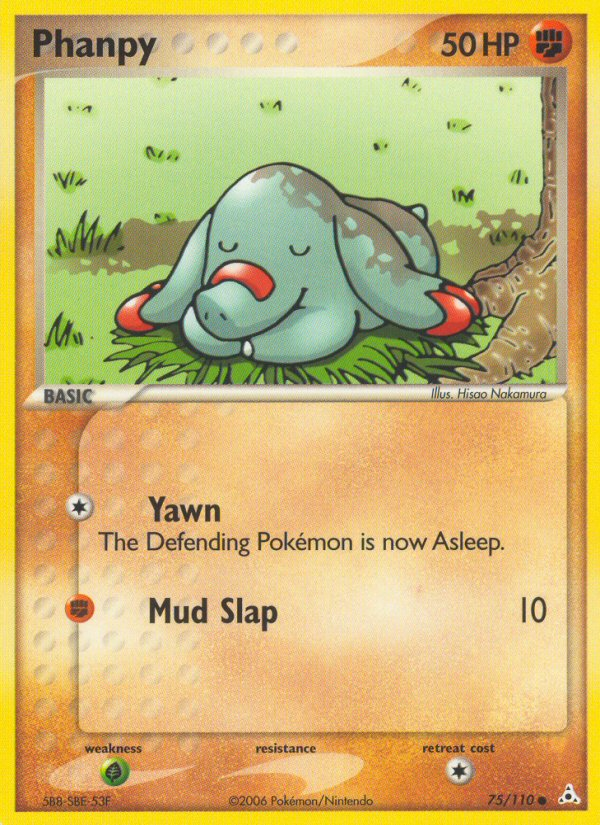
Image courtesy of TCGdex.net
Balancing Phanpy's Evolution: Donphan in the Pokémon TCG
In the intricate ecosystem of the Pokémon Trading Card Game, evolution chains are a delicate dance between pace, power, and probability. Designers constantly test how a basic creature can morph into a more demanding late-game threat without tipping the scales too far in one direction. Phanpy, a modest Fighting-type from the Holon Phantoms era, provides a clean lens for exploring how a simple evolution line is tuned. With a humble 50 HP and two accessible attacks, Phanpy is a perfect case study for how early-game tempo and progression influence the path to a balanced Donphan.
Phanpy at a glance: stats, art, and purpose
- Name: Phanpy
- Set: Holon Phantoms (EX13)
- Rarity: Common
- Type: Fighting
- Stage: Basic
- HP: 50
- Attacks:
- Yawn — Cost: Colorless — Effect: The Defending Pokémon is now Asleep.
- Mud Slup — Cost: Fighting — Damage: 10
- Weakness: Grass ×2
- Illustrator: Hisao Nakamura
Holon Phantoms gives Phanpy a classic, approachable footprint: a low-HP basic that hinges on a smooth evolution into a stronger Donphan. The Yawn attack showcases a stall-oriented, strategic element, letting you slow an opponent while you set up the next stage. Mud Slup provides a simple, reliable source of damage for early tempo. This combination—defensive stall with a modest offensive punch—creates a realistic sandbox for testing how a creature transitions into a more demanding evolutionary line.
Why balance matters in evolution lines
When you design Donphan’s predecessor, you want Phanpy to feel like a meaningful stepping-stone rather than a bottleneck. If Phanpy is too fragile (HP too low) or its two attacks are too inconsequential, players may skip the line in favor of quicker, more explosive plays. Conversely, if Donphan’s eventual form is too potent too early, it can overshadow other teammates and compress the game’s strategic diversity. In practice, a 50 HP baseline invites thoughtful evolution timing, energy management, and synergy with the rest of the deck.
From a balance testing perspective, the colorless Yawn and the fighting-cost Mud Slup embody different design pressures. Yawn’s sleep effect is a tactical tool that can swing turns and buy precious setup time. However, since the defending Pokémon falls asleep rather than taking immediate extra damage, you’re incentivized to design Donphan’s emergence to capitalize on those moments without letting Phanpy’s raw stats carry the load alone. The Grass weakness ×2 is another important lever: it creates natural counterplay and encourages players to think about type matchups in the evolving chain.
Strategic takeaways for players and deck builders
- Tempo vs. power: Phanpy’s job is to buy you turns to evolve. Leverage Yawn to stall and open space for Donphan’s big finish, but don’t rely on it as a sole win condition.
- Energy management: With a Colorless-based first attack and a Fighting-based second, Phanpy asks you to plan your energy across turns. Donphan’s arrival should feel like a natural upgrade, not a cram-job of resources.
- Synergy with support cards: Supporting the evolution path with trainer effects that fetch or accelerate evolutions can smooth the transition. In practice, you want cards that keep Phanpy safe while you dig for Donphan’s final form and a reliable follow-up attacker.
- Positioning in a lineup: Phanpy’s basic presence is a gateway to a bigger threat. Use it to anchor early turns while your bench fills with evolutions and complementary attackers that benefit from opponent’s slowed pace.
For collectors, the Holon Phantoms era is a treasure trove of art and flavor. Nakamura’s illustration brings a warm, approachable aesthetic to a creature that could otherwise vanish into the crowd of early-stage Pokémon. The card’s holo and reverse-holo variants add visual depth, appealing to both nostalgia and display value.
Market signals and collectible insights
From a pricing perspective, Phanpy ex13-75 sits in a fascinating spot. Standard non-holo copies historically trend toward accessibility, while holo and reverse-holo variants can command more attention among collectors who value the set’s aesthetic and the character’s role in the evolution narrative. Recent market data suggests a spectrum where baseline copies hover in the low tenths of a dollar, while holo variants can scale into the dollar range depending on supply and demand. The card’s elegance is not merely in its playability but also in its place within a beloved era of the TCG’s evolution storytelling.
As a common card with a clear evolutionary hook, Phanpy remains relevant for players building at the entry level and seasoned collectors who chase Holon Phantoms nostalgia. The illustrator’s signature style, coupled with a design that invites players to consider tempo, transition, and type matchups, makes this card a thoughtful piece for a balanced evolution plan. ⚡🔥💎
Putting it into practice: a quick build idea
Imagine a small, cohesive shell that uses Phanpy as the setup muscle for Donphan’s big moment. You’d want a handful of supportive trainers to keep Phanpy in play and a few early-stage attackers to apply pressure while you search for Donphan. The plan hinges on weathering the early game with Yawn-enabled stalls and then flipping the momentum with Donphan’s evolved frame—keeping the opponent guessing and your board stable.
Neon Gaming Mouse Pad Rectangle 1/16 Inch Thick Rubber BaseInterested in more from the network? Explore the five articles below for a broader look at design, evolution, and open-world exploration across gaming and beyond. 🎴🎨🎮
More from our network
- https://transparent-paper.shop/blog/post/designing-habit-tracker-printables-for-self-improvement/
- https://blog.digital-vault.xyz/blog/post/distant-blue-giant-reveals-temperature-gradients-shaping-evolution/
- https://crypto-acolytes.xyz/blog/post/top-classic-n64-multiplayer-titles-you-must-play/
- https://crypto-acolytes.xyz/blog/post/exploring-space-wrecks-in-open-world-games/
- https://crypto-acolytes.xyz/blog/post/opengl-legacy-in-pc-gaming-why-it-still-matters/