

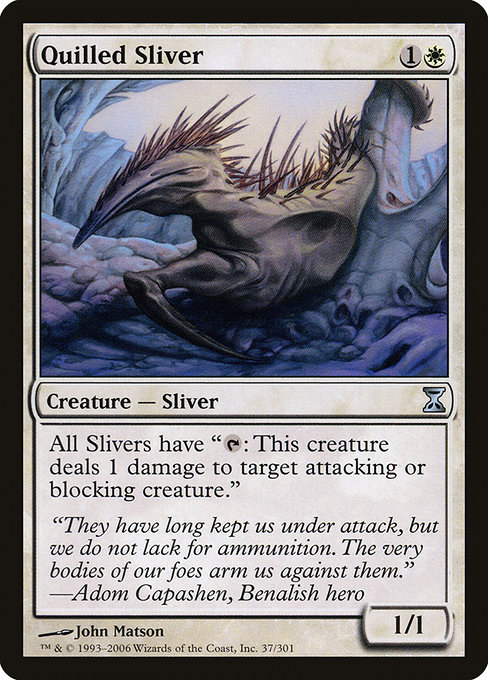
Image courtesy of Scryfall.com
Regional Dynamics of Sliver Prices and Collector Behavior
If you’ve ever chased a creature with a hive-mind twist, Quilled Sliver offers a perfect lens into how regional markets diverge for classic MTG staples 🧙♂️🔥. Released in Time Spiral on 2006-10-06, this uncommon white Sliver isn’t the headliner in most constructed formats, but it embodies a recurring truth of the secondary market: print runs, localization, and local demand shape value just as much as a card’s power on the battlefield. Across continents, the same 2-cost creature can wear vastly different prices, and collectors behave differently depending on where they’re shopping. That divergence isn’t a bug—it's part of the MTG ecosystem’s charm 💎.
Quilled Sliver is small in raw stats—2 mana total, a 1/1 body, and a single ability that upgrades every Sliver to a tiny demolition squad: “All Slivers have {T}: This permanent deals 1 damage to target attacking or blocking creature.” It’s a neat tribal enabler that rewards synergy with other Slivers, turning a board of little one-drops into a disciplined, shared toolkit ⚔️. The card’s identity—white, sliver-themed, and flavorfully anchored by the Benalish line in its flavor text—gives it a place in casual tribal decks and as a collector’s piece for fans of the lineage. The artwork by John Matson captures a crisp, period-specific sensibility that many artists associate with the Time Spiral era 🎨.
They have long kept us under attack, but we do not lack for ammunition. The very bodies of our foes arm us against them. — Adom Capashen, Benalish hero
From a collector’s standpoint, the card’s print history matters. Quilled Sliver is printed in Time Spiral (tsp), and while it remains legal in formats like Modern and Legacy, its value is driven more by regional supply and foil demand than by sheer gameplay power. In many markets, foil versions command a noticeable premium due to limited regional foil print runs and the allure of shiny borderless-looking cards in a tribal deck. The non-foil version typically sits closer to the low hundreds of cents, while the foil can push into several dollars in climates where Sliver decks retain nostalgic appeal or where foil slivers are chased by newer collectors 🔥💎.
To anchor this with a concrete snapshot drawn from widely used data sources, Scryfall lists Quilled Sliver’s USD price around $0.49 for non-foil and about $6.00 for foil, with Euro equivalents around €0.19 non-foil and €1.01 foil. Those numbers aren’t a universal truth—local shops, currency swings, and shipping costs can swing the actual price by a factor of 2–3 or more in some months—but they provide a baseline for understanding regional differences. The market window for a card like this is often wider than most newer rares, which means price volatility tends to reflect macro trends in currency and collector interest as much as card availability 🧭.
What drives regional variation in practice?
- Supply chains and import costs: Cards sourced from abroad may carry higher shipping fees or import duties, inflating prices in regions with smaller local Wizards of the Coast print runs. In some areas, a few foil copies appear and disappear quickly, creating price spikes that entice speculators and casual buyers alike.
- Local demand for Sliver tribal themes: Regions where Sliver decks still see casual play or nostalgia-driven buying can sustain higher prices for older Slivers, especially foils. In markets with fewer available copies, collectors may bid up the price to secure a key piece for a collection or a niche deck.
- Currency and tax environments: If a market skews toward strong competition among vendors, exchange rate movements can widen price gaps between USD-denominated and Euro- or GBP-denominated markets, even for the same card and print run.
- Language, art, and regional promos: Variants and language-localized printings, along with card sleeves and display foils, can subtly color demand. Some collectors prize specific art or border treatments that only show up in certain printings or promotions, feeding cross-market interest.
- Secondary-market platforms: In Europe, Cardmarket and similar hubs can consolidate regional liquidity differently from North American powerhouses like TCGPlayer. The distribution of buyers and sellers across these platforms nudges price floors and ceilings in visible, real-time ways 🧭.
Traders and collectors navigating these waters often follow a few practical patterns. They watch multiple markets for arbitrage opportunities, convert currencies with care, and keep an eye on foil-heavy demand cycles around local conventions or big vintage events. For regional players, Quilled Sliver’s status as an uncommon with a durable foil draw makes it a candidate for both casual acquisitions and longer-term investment—especially when the broader Sliver tribal theme remains a talking point in meme-worthy decks and retro flashbacks 🎲.
Tips for collectors and players tracking Quilled Sliver
- Track both foil and non-foil listings across at least two major markets to spot price momentum and identify cheap buy-in windows. Foils often carry more pronounced regional spikes.
- Consider currency trends and local tax impacts when budgeting for a region-specific purchase. A “cheap” card in one currency can become more expensive after conversion and shipping costs.
- Use a blended portfolio approach: hold a mix of near-term playable copies and a few foil or lightly played pieces for long-term value as tribal interest persists or resurgences appear in Modern or Legacy lists 🧙♂️.
- Keep an eye on reprint risk and rotation cycles. Time Spiral history means prints may be scarce, preserving a floor price in some markets while others see more supply.
- Leverage cross-promotional products—like practical MTG-themed gear—to scratch the shopping itch while you monitor card prices. The featured phone case with a card holder is a handy companion for casual play and trades on the go 🔥.
As you reflect on price signals and collector behavior, remember that a card like Quilled Sliver sits at a delightful intersection of playability, nostalgia, and regional economics. It’s a reminder that MTG’s worth isn’t just measured by arithmetic on a price chart; it’s the stories, the decks you build, and the communities you meet across borders that keep a card’s spirit alive 🧙♂️⚔️.
Phone Case with Card Holder Impact Resistant PolycarbonateMore from our network
- https://crypto-acolytes.xyz/blog/post/pokemon-crystal-the-definitive-johto-experience/
- https://articles.digital-vault.xyz/blog/post/forsaken-crossroads-performance-by-deck-archetype-explored/
- https://blog.digital-vault.xyz/blog/post/ms-bumbleflower-and-the-mtg-fun-vs-competition-dilemma/
- https://blog.crypto-articles.xyz/blog/post/nft-data-george-plays-clash-royale-1053-from-gpcr-nft-collection-collection-on-magiceden/
- https://transparent-paper.shop/blog/post/build-a-django-powered-digital-download-business/
Quilled Sliver
All Slivers have "{T}: This permanent deals 1 damage to target attacking or blocking creature."
ID: 72486240-eabb-4b37-99cc-ab13413683fa
Oracle ID: beb39342-5272-41a4-a470-9f2bf0cd0f92
Multiverse IDs: 111051
TCGPlayer ID: 14336
Cardmarket ID: 13955
Colors: W
Color Identity: W
Keywords:
Rarity: Uncommon
Released: 2006-10-06
Artist: John Matson
Frame: 2003
Border: black
EDHRec Rank: 18619
Penny Rank: 9436
Set: Time Spiral (tsp)
Collector #: 37
Legalities
- Standard — not_legal
- Future — not_legal
- Historic — not_legal
- Timeless — not_legal
- Gladiator — not_legal
- Pioneer — not_legal
- Modern — legal
- Legacy — legal
- Pauper — not_legal
- Vintage — legal
- Penny — not_legal
- Commander — legal
- Oathbreaker — legal
- Standardbrawl — not_legal
- Brawl — not_legal
- Alchemy — not_legal
- Paupercommander — not_legal
- Duel — legal
- Oldschool — not_legal
- Premodern — not_legal
- Predh — legal
Prices
- USD: 0.49
- USD_FOIL: 6.00
- EUR: 0.19
- EUR_FOIL: 1.01
- TIX: 0.03
More from our network
- https://wiki.digital-vault.xyz/wiki/post/pokemon-tcg-stats-metang-card-id-np-23/
- https://rusty-articles.xyz/tmpn9awmn0a/index.html
- https://blog.zero-static.xyz/blog/post/humor-fuels-mtg-culture-bolrac-clan-basher/
- https://crypto-acolytes.xyz/blog/post/nft-stats-tardio-1766-from-tardio-collection/
- https://wiki.digital-vault.xyz/wiki/post/pokemon-tcg-stats-sophocles-card-id-sm3-123/